This is fairly simple, you can see the pinouts here:
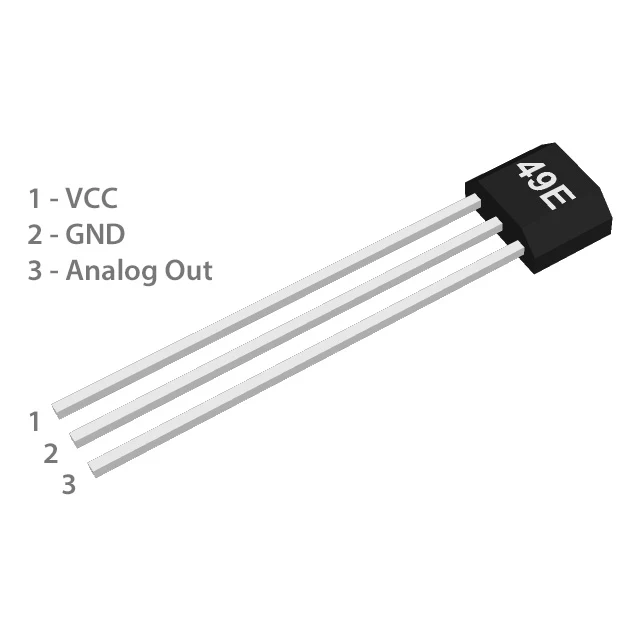
Pins to connect:
- OUT to ADC in on your STM32 ( configure in STMCubeIDE )
- 3v3 & GND
#include <stdio.h>
#include <stdint.h>

const float GAUSS_PER_STEP = 2.57;
float zeroLevel = 2030; // change so zero'd level is 0 for you
float gaussValue = 0.0;
int main(void) {
    // Hal init stuff
	while (1) {
		HAL_ADC_Start(&hadc1);
		if (HAL_ADC_PollForConversion(&hadc1, 1000000) == HAL_OK) {
			zerodValue = (int32_t) HAL_ADC_GetValue(&hadc1) - (int32_t) zeroLevel;
			// Convert to gauss as integer (multiply by 257 then divide by 100 to get 2.57 effect)
			gaussValue_int = (zerodValue * 257) / 100;
		} else {
			// ADC conversion failed - display error or use previous values
			zerodValue = 9999;  // Error indicator
			gaussValue_int = 9999;
		}
		HAL_ADC_Stop(&hadc1);
        // Do something with it, I put it into a buffer not mentioned here as I am sending it to a display
		snprintf(bufferRaw, sizeof(bufferRaw), "%ld", (long) zerodValue);
		snprintf(bufferGauss, sizeof(bufferGauss), "%ld",
				(long) gaussValue_int);
		HAL_Delay(100);
	}
}
#=> Basic version is: rawValue=HAL_ADC_GetValue(&hadc1)
Full code
Things to bear in mind:
- I have a screen wired up, this won’t work if you don’t have the library HERE added
- I have configured most of this via the STM32CubeIde
/* USER CODE BEGIN Header */
/**
 ******************************************************************************
 * @file           : main.c
 * @brief          : Main program body
 ******************************************************************************
 * @attention
 *
 * Copyright (c) 2025 STMicroelectronics.
 * All rights reserved.
 *
 * This software is licensed under terms that can be found in the LICENSE file
 * in the root directory of this software component.
 * If no LICENSE file comes with this software, it is provided AS-IS.
 *
 ******************************************************************************
 */
/* USER CODE END Header */
/* Includes ------------------------------------------------------------------*/
#include "main.h"
#include "stm32f1xx_hal.h"
#include "stm32f1xx_hal_adc.h"
#include "stm32f1xx_hal_def.h"
#include "stm32f1xx_hal_uart.h"

/* Private includes ----------------------------------------------------------*/
/* USER CODE BEGIN Includes */
#include "ssd1306.h"
#include "fonts.h"
#include <stdio.h>
#include <stdint.h>

/* USER CODE END Includes */

/* Private typedef -----------------------------------------------------------*/
/* USER CODE BEGIN PTD */

/* USER CODE END PTD */

/* Private define ------------------------------------------------------------*/
/* USER CODE BEGIN PD */

/* USER CODE END PD */

/* Private macro -------------------------------------------------------------*/
/* USER CODE BEGIN PM */

/* USER CODE END PM */

/* Private variables ---------------------------------------------------------*/
ADC_HandleTypeDef hadc1;

I2C_HandleTypeDef hi2c2;

SPI_HandleTypeDef hspi2;

UART_HandleTypeDef huart1;

/* USER CODE BEGIN PV */

/* USER CODE END PV */

/* Private function prototypes -----------------------------------------------*/
void SystemClock_Config(void);
static void MX_GPIO_Init(void);
static void MX_USART1_UART_Init(void);
static void MX_ADC1_Init(void);
static void MX_I2C2_Init(void);
static void MX_SPI2_Init(void);
/* USER CODE BEGIN PFP */

/* USER CODE END PFP */

/* Private user code ---------------------------------------------------------*/
/* USER CODE BEGIN 0 */
const float GAUSS_PER_STEP = 2.57;
float zeroLevel = 2030;
float gaussValue = 0.0;
/* USER CODE END 0 */

/**
 * @brief  The application entry point.
 * @retval int
 */
int main(void) {

	/* USER CODE BEGIN 1 */

	/* USER CODE END 1 */

	/* MCU Configuration--------------------------------------------------------*/

	/* Reset of all peripherals, Initializes the Flash interface and the Systick. */
	HAL_Init();

	/* USER CODE BEGIN Init */

	/* USER CODE END Init */

	/* Configure the system clock */
	SystemClock_Config();

	/* USER CODE BEGIN SysInit */

	/* USER CODE END SysInit */

	/* Initialize all configured peripherals */
	MX_GPIO_Init();
	MX_USART1_UART_Init();
	MX_ADC1_Init();
	MX_I2C2_Init();
	MX_SPI2_Init();
	/* USER CODE BEGIN 2 */
	ssd1306_Init(&hi2c2);
	/* USER CODE END 2 */

	/* Infinite loop */
	/* USER CODE BEGIN WHILE */
	while (1) {
		/* USER CODE END WHILE */
		int32_t zerodValue = 0;  // Single declaration with correct type
		int32_t gaussValue_int = 0;  // Integer version
		char bufferRaw[12];
		char bufferGauss[12];

		HAL_ADC_Start(&hadc1);
		if (HAL_ADC_PollForConversion(&hadc1, 1000000) == HAL_OK) {
			zerodValue = (int32_t) HAL_ADC_GetValue(&hadc1)
					- (int32_t) zeroLevel;
			// Convert to gauss as integer (multiply by 257 then divide by 100 to get 2.57 effect)
			gaussValue_int = (zerodValue * 257) / 100;
		} else {
			// ADC conversion failed - display error or use previous values
			zerodValue = 9999;  // Error indicator
			gaussValue_int = 9999;
		}
		HAL_ADC_Stop(&hadc1);

		snprintf(bufferRaw, sizeof(bufferRaw), "%ld", (long) zerodValue);
		snprintf(bufferGauss, sizeof(bufferGauss), "%ld",
				(long) gaussValue_int);

		ssd1306_Fill(Black);
		ssd1306_SetCursor(0, 0);
		ssd1306_WriteString("Raw: ", Font_7x10, White);
		ssd1306_SetCursor(35, 0);
		ssd1306_WriteString(bufferRaw, Font_7x10, White);
		ssd1306_SetCursor(0, 10);
		ssd1306_WriteString("Gauss: ", Font_7x10, White);
		ssd1306_SetCursor(49, 10);
		ssd1306_WriteString(bufferGauss, Font_7x10, White);

		ssd1306_UpdateScreen(&hi2c2);
		HAL_Delay(100);
	}
	/* USER CODE END 3 */
}

/**
 * @brief System Clock Configuration
 * @retval None
 */
void SystemClock_Config(void) {
	RCC_OscInitTypeDef RCC_OscInitStruct = { 0 };
	RCC_ClkInitTypeDef RCC_ClkInitStruct = { 0 };
	RCC_PeriphCLKInitTypeDef PeriphClkInit = { 0 };

	/** Initializes the RCC Oscillators according to the specified parameters
	 * in the RCC_OscInitTypeDef structure.
	 */
	RCC_OscInitStruct.OscillatorType = RCC_OSCILLATORTYPE_HSE;
	RCC_OscInitStruct.HSEState = RCC_HSE_ON;
	RCC_OscInitStruct.HSEPredivValue = RCC_HSE_PREDIV_DIV2;
	RCC_OscInitStruct.HSIState = RCC_HSI_ON;
	RCC_OscInitStruct.PLL.PLLState = RCC_PLL_ON;
	RCC_OscInitStruct.PLL.PLLSource = RCC_PLLSOURCE_HSE;
	RCC_OscInitStruct.PLL.PLLMUL = RCC_PLL_MUL9;
	if (HAL_RCC_OscConfig(&RCC_OscInitStruct) != HAL_OK) {
		Error_Handler();
	}

	/** Initializes the CPU, AHB and APB buses clocks
	 */
	RCC_ClkInitStruct.ClockType = RCC_CLOCKTYPE_HCLK | RCC_CLOCKTYPE_SYSCLK
			| RCC_CLOCKTYPE_PCLK1 | RCC_CLOCKTYPE_PCLK2;
	RCC_ClkInitStruct.SYSCLKSource = RCC_SYSCLKSOURCE_PLLCLK;
	RCC_ClkInitStruct.AHBCLKDivider = RCC_SYSCLK_DIV1;
	RCC_ClkInitStruct.APB1CLKDivider = RCC_HCLK_DIV2;
	RCC_ClkInitStruct.APB2CLKDivider = RCC_HCLK_DIV1;

	if (HAL_RCC_ClockConfig(&RCC_ClkInitStruct, FLASH_LATENCY_2) != HAL_OK) {
		Error_Handler();
	}
	PeriphClkInit.PeriphClockSelection = RCC_PERIPHCLK_ADC;
	PeriphClkInit.AdcClockSelection = RCC_ADCPCLK2_DIV6;
	if (HAL_RCCEx_PeriphCLKConfig(&PeriphClkInit) != HAL_OK) {
		Error_Handler();
	}
}

/**
 * @brief ADC1 Initialization Function
 * @param None
 * @retval None
 */
static void MX_ADC1_Init(void) {

	/* USER CODE BEGIN ADC1_Init 0 */

	/* USER CODE END ADC1_Init 0 */

	ADC_ChannelConfTypeDef sConfig = { 0 };

	/* USER CODE BEGIN ADC1_Init 1 */

	/* USER CODE END ADC1_Init 1 */

	/** Common config
	 */
	hadc1.Instance = ADC1;
	hadc1.Init.ScanConvMode = ADC_SCAN_DISABLE;
	hadc1.Init.ContinuousConvMode = DISABLE;
	hadc1.Init.DiscontinuousConvMode = DISABLE;
	hadc1.Init.ExternalTrigConv = ADC_SOFTWARE_START;
	hadc1.Init.DataAlign = ADC_DATAALIGN_RIGHT;
	hadc1.Init.NbrOfConversion = 1;
	if (HAL_ADC_Init(&hadc1) != HAL_OK) {
		Error_Handler();
	}

	/** Configure Regular Channel
	 */
	sConfig.Channel = ADC_CHANNEL_1;
	sConfig.Rank = ADC_REGULAR_RANK_1;
	sConfig.SamplingTime = ADC_SAMPLETIME_1CYCLE_5;
	if (HAL_ADC_ConfigChannel(&hadc1, &sConfig) != HAL_OK) {
		Error_Handler();
	}
	/* USER CODE BEGIN ADC1_Init 2 */

	/* USER CODE END ADC1_Init 2 */

}

/**
 * @brief I2C2 Initialization Function
 * @param None
 * @retval None
 */
static void MX_I2C2_Init(void) {

	/* USER CODE BEGIN I2C2_Init 0 */

	/* USER CODE END I2C2_Init 0 */

	/* USER CODE BEGIN I2C2_Init 1 */

	/* USER CODE END I2C2_Init 1 */
	hi2c2.Instance = I2C2;
	hi2c2.Init.ClockSpeed = 100000;
	hi2c2.Init.DutyCycle = I2C_DUTYCYCLE_2;
	hi2c2.Init.OwnAddress1 = 0;
	hi2c2.Init.AddressingMode = I2C_ADDRESSINGMODE_7BIT;
	hi2c2.Init.DualAddressMode = I2C_DUALADDRESS_DISABLE;
	hi2c2.Init.OwnAddress2 = 0;
	hi2c2.Init.GeneralCallMode = I2C_GENERALCALL_DISABLE;
	hi2c2.Init.NoStretchMode = I2C_NOSTRETCH_DISABLE;
	if (HAL_I2C_Init(&hi2c2) != HAL_OK) {
		Error_Handler();
	}
	/* USER CODE BEGIN I2C2_Init 2 */

	/* USER CODE END I2C2_Init 2 */

}

/**
 * @brief SPI2 Initialization Function
 * @param None
 * @retval None
 */
static void MX_SPI2_Init(void) {

	/* USER CODE BEGIN SPI2_Init 0 */

	/* USER CODE END SPI2_Init 0 */

	/* USER CODE BEGIN SPI2_Init 1 */

	/* USER CODE END SPI2_Init 1 */
	/* SPI2 parameter configuration*/
	hspi2.Instance = SPI2;
	hspi2.Init.Mode = SPI_MODE_MASTER;
	hspi2.Init.Direction = SPI_DIRECTION_2LINES;
	hspi2.Init.DataSize = SPI_DATASIZE_8BIT;
	hspi2.Init.CLKPolarity = SPI_POLARITY_LOW;
	hspi2.Init.CLKPhase = SPI_PHASE_1EDGE;
	hspi2.Init.NSS = SPI_NSS_SOFT;
	hspi2.Init.BaudRatePrescaler = SPI_BAUDRATEPRESCALER_2;
	hspi2.Init.FirstBit = SPI_FIRSTBIT_MSB;
	hspi2.Init.TIMode = SPI_TIMODE_DISABLE;
	hspi2.Init.CRCCalculation = SPI_CRCCALCULATION_DISABLE;
	hspi2.Init.CRCPolynomial = 10;
	if (HAL_SPI_Init(&hspi2) != HAL_OK) {
		Error_Handler();
	}
	/* USER CODE BEGIN SPI2_Init 2 */

	/* USER CODE END SPI2_Init 2 */

}

/**
 * @brief USART1 Initialization Function
 * @param None
 * @retval None
 */
static void MX_USART1_UART_Init(void) {

	/* USER CODE BEGIN USART1_Init 0 */

	/* USER CODE END USART1_Init 0 */

	/* USER CODE BEGIN USART1_Init 1 */

	/* USER CODE END USART1_Init 1 */
	huart1.Instance = USART1;
	huart1.Init.BaudRate = 9600;
	huart1.Init.WordLength = UART_WORDLENGTH_8B;
	huart1.Init.StopBits = UART_STOPBITS_1;
	huart1.Init.Parity = UART_PARITY_NONE;
	huart1.Init.Mode = UART_MODE_TX_RX;
	huart1.Init.HwFlowCtl = UART_HWCONTROL_NONE;
	huart1.Init.OverSampling = UART_OVERSAMPLING_16;
	if (HAL_UART_Init(&huart1) != HAL_OK) {
		Error_Handler();
	}
	/* USER CODE BEGIN USART1_Init 2 */

	/* USER CODE END USART1_Init 2 */

}

/**
 * @brief GPIO Initialization Function
 * @param None
 * @retval None
 */
static void MX_GPIO_Init(void) {
	/* USER CODE BEGIN MX_GPIO_Init_1 */

	/* USER CODE END MX_GPIO_Init_1 */

	/* GPIO Ports Clock Enable */
	__HAL_RCC_GPIOD_CLK_ENABLE();
	__HAL_RCC_GPIOA_CLK_ENABLE();
	__HAL_RCC_GPIOB_CLK_ENABLE();

	/* USER CODE BEGIN MX_GPIO_Init_2 */

	/* USER CODE END MX_GPIO_Init_2 */
}

/* USER CODE BEGIN 4 */

/* USER CODE END 4 */

/**
 * @brief  This function is executed in case of error occurrence.
 * @retval None
 */
void Error_Handler(void) {
	/* USER CODE BEGIN Error_Handler_Debug */
	/* User can add his own implementation to report the HAL error return state */
	__disable_irq();
	while (1) {
	}
	/* USER CODE END Error_Handler_Debug */
}
#ifdef USE_FULL_ASSERT
/**
  * @brief  Reports the name of the source file and the source line number
  *         where the assert_param error has occurred.
  * @param  file: pointer to the source file name
  * @param  line: assert_param error line source number
  * @retval None
  */
void assert_failed(uint8_t *file, uint32_t line)
{
  /* USER CODE BEGIN 6 */
  /* User can add his own implementation to report the file name and line number, ex: printf("Wrong parameters value: file %s on line %d\r\n", file, line) */
  /* USER CODE END 6 */
}
#endif /* USE_FULL_ASSERT */